





“A Tragedy of Telepaths”
Written by J. Michael Staczynski
Directed by Tony Dow
Season 5, Episode 10
Production episode 510
Original air date: March 25, 1998
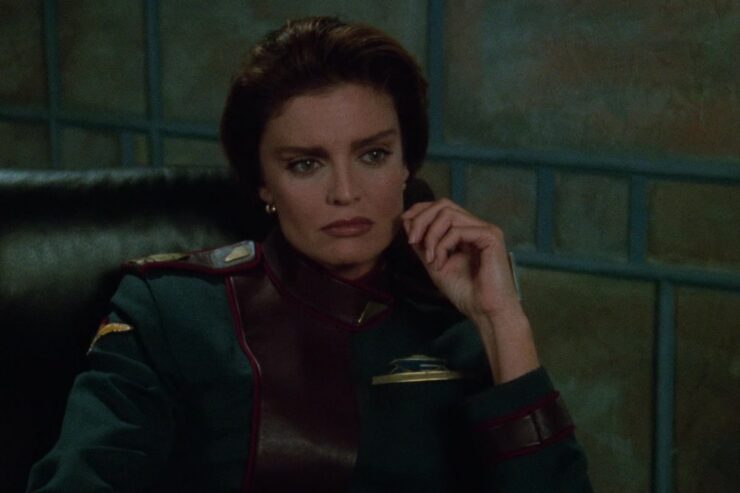
It was the dawn of the third age… We open with Lochley providing a personal log voiceover bringing us up to speed: the telepaths have locked themselves in downbelow, and Lochley is stuck dealing with it alone, as Sheridan is far too busy dealing with the various IA ambassadors, who are pissed about their cargo ships being attacked. She has only one solution that she thinks will work: she has CnC put in a call to Bester.
Lochley asks Allan for an update. The problem is that every time a welder starts to make progress in cutting through the bulkheads, the telepaths make him think something’s wrong—the latest is the worker is convinced that there’s a bomb in the wall—at which point they have to get another cutter and start all over again.
After telling Allan to keep trying, she announces that she’s going to go through the very tiny maintenance hatch herself to go talk to them. Allan objects, she overrules his objection.
On Centauri Prime, Mollari is bumfuzzled by the fact that the military’s production budget has increased. This usually only happens when they’re at war—which they aren’t at the moment. G’Kar suggests that the Centauri have decided to invade themselves.

Mollari is revolted by the fact that G’Kar is eating fresh spoo. He saw a cart taking it to a wing of the palace and grabbed a bowl. But only Narns can tolerate eating fresh spoo—Centauri can only eat it after it’s processed. Mollari reveals that the wing of the palace the cart was being taken to includes the dungeon. Realizing that the spoo is probably for a Narn prisoner—of which there shouldn’t be any anymore—G’Kar demands that they investigate.
They check the cells to find Na’Toth. She’s been there for a couple of years now, having been on the Narn homeworld when it was bombarded. She was brought to Centauri Prime for “entertainment.” She’s been in the cell for some time, and Mollari—after swearing up and down to G’Kar that he had no idea she was there—assumes that she was forgotten and slipped through the cracks. The problem is, the emperor is the one who put her there, which means that Mollari, who is the prime minister and therefore of lesser rank, cannot countermand it. Only the Regent can, and he’s not likely to be an ally in this. But Mollari does promise G’Kar and Na’Toth that he will find a way to get her out.
On B5, Lochley makes it through the ductwork and is taken to Byron, who telepathically encouraged her to come. However, Byron makes it clear that they won’t leave their improvised bunker, and they also won’t give up the telepaths who are still roaming free on the station. Lochley asks Byron’s followers to come peacefully with her, but nobody takes her up on it. Frustrated, she asks Byron why he summoned her here if he wasn’t going to help, and he says he wanted to her to know directly what Byron’s thoughts and plans were. Lochley has been fair to them, even when she’s disagreed, and Byron appreciates that.

Garibaldi and Sheridan, after discussing Lochley’s batshit plan, talk about the cargo ship attacks, talk about the latest wrinkle in the attacks on cargo ships: the Drazi found a fragment from a Brakiri ship in their latest attack.
On Centauri Prime, G’Kar informs Mollari that he has found a transport that will rendezvous with them when they return to B5 and take Na’Toth back to Narn. Now they just have to smuggle her out somehow. A woman comes to give Mollari some news, and the prime minster gets an idea, asking the woman to loan him her clothes…
On B5, the Drazi ambassador accuses the Brakiri of being behind the attacks. But then the Gaim ambassador announces that they found a fragment from a Drazi ship in the wreckage from an attack on them. Sheridan points out that this feels like a setup and also adds that they examined the wreckage, and found that the fragments were cut, not blown off by weapons fire. The respective nations are still massing their militaries, so Sheridan makes it clear that the White Star fleet is watching them. The ambassadors are not happy about any of this.
On Centauri Prime, Mollari goes to Na’Toth’s cell and orders the guard to stop guarding her cell. There’s to be no food or water delivered there henceforth, and in three days, the cell is to be walled off. Na’Toth believes that this means her death, but then Mollari and G’Kar remove her from the cell, dressed now in Centauri finery, along with a veil. They head toward the transport, Mollari being loud and obnoxious and seemingly drunk, while flirting with the woman who appears to be a Centauri female, albeit with her face covered. They make it to the transport, with no one the wiser, and Na’Toth is sent home.
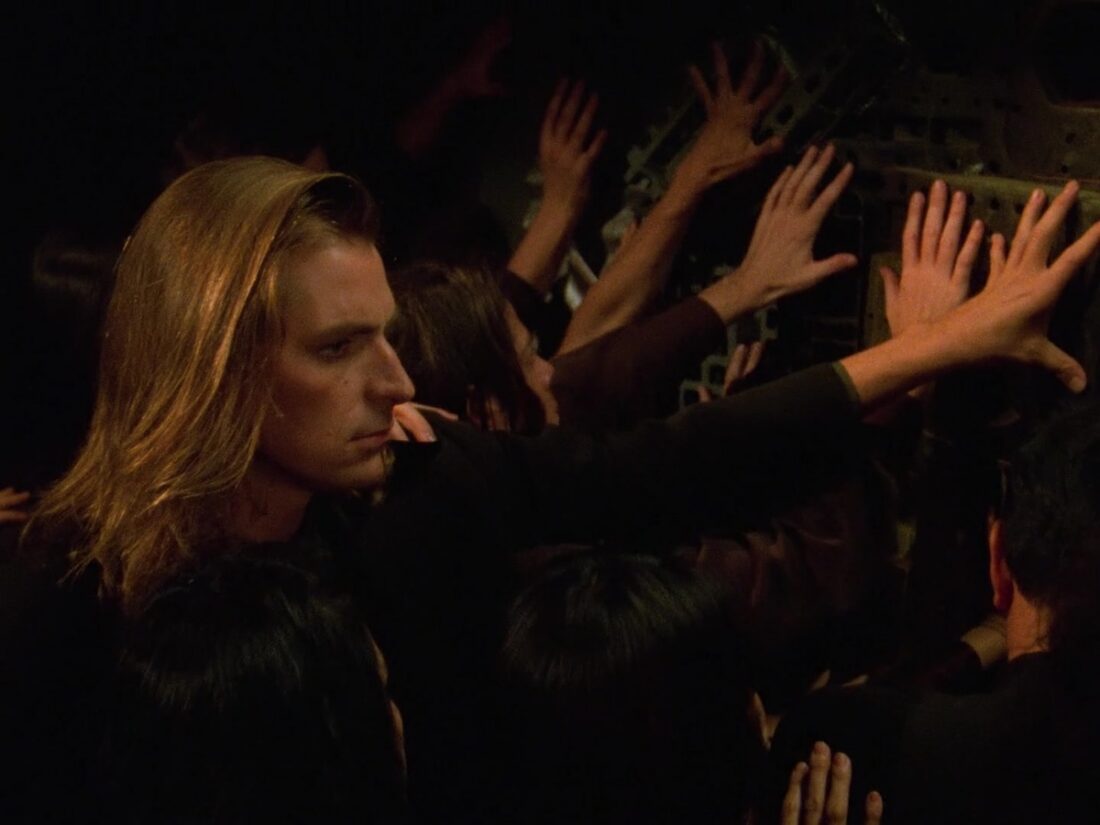
Bester arrives on B5. The rogue telepaths who are still at large sense his presence, and assume (correctly) that the bloodhounds aren’t far behind. They head to the armory. Meanwhile, Bester is brought to where the cutter was working and he removes the image of the bomb from his head and he also “pushes” the telepaths away from the wall.

However, the rogue telepaths then ambush Bester, Allan, and the rest. Byron senses this and is saddened that people are being shot and killed in his name.
Bester’s bloodhounds arrive soon thereafter, and we end as we began, with Lochley providing a personal log, expressing her sad belief that there is no way any of this will end well.
Get the hell out of our galaxy! Sheridan is not having a very good time, as the IA is already starting to fall apart thanks to these attacks.
Never work with your ex. Allan wants Lochley to take a PPG with her to meet the telepaths. Lochley rightly points out that there are a lot more of them and a PPG won’t help her if they decide to attack her. Better to be unarmed and non-provocative.
The household god of frustration. Garibaldi gives a speech talking about how history isn’t defined by peace, it’s defined by wars, because wars are more exciting.
In the glorious days of the Centauri Republic… Mollari tells a story from when he was a child about a guard who always stood in the garden. Apparently, years ago, the emperor’s daughter was worried about a particular flower and so ordered a guard to stand over it to make sure it remained unharmed. The young woman eventually forgot about the flower and the flower itself died—but the order was never rescinded, and so a guard continued to be assigned to that part of the garden thenceforth. He tells that story to illustrate why he can’t simply order Na’Toth to be freed.
Though it take a thousand years, we will be free. Na’Toth was on the Narn homeworld when it was bombarded. She has spent the last couple of years in a cell not knowing that Narn has been freed. She tells Mollari that she’d kill him if she had the strength, and Mollari allows as how she’d have to wait in line.

The Corps is mother, the Corps is father. Bester gets to say “I told you so” to Lochley when she summons him to the station to deal with Byron and his gaggle.
No sex, please, we’re EarthForce. The servant who delivers the message to Mollari and then is asked to remove her clothes is very accommodating, as she apparently did many a sexual favor for Cartagia. Both Mollari and G’Kar waggle their eyebrows at the whole thing, and it’s all very yucky.
Welcome aboard. Several recurring characters in this one: Walter Koenig, back from “Strange Relations” as Bester; Robin Atkin Downes, back from “In the Kingdom of the Blind” as Byron; Jonathan Chapman, back from “Day of the Dead” as the Brakiri ambassador; Kim Strauss, back from “The Paragon of Animals” as the Drazi ambassador; and Leigh J. McCloskey, debuting the role of Thomas. Koenig, Downes, and McCloskey will be back next time in “Phoenix Rising,” while Chapman and Strauss will return in “And All My Dreams, Torn Asunder.”
But the big guest is the return of Julie Caitlin Brown as Na’Toth. The character last appeared in “Acts of Sacrifice,” played by Mary Kay Adams, while Brown last appeared in the role in “Chrysalis.” (Brown also played Corey in “There All the Honor Lies.”)
Trivial matters. Na’Toth was last mentioned in “And the Rock Cried Out, No Hiding Place,” but was not seen, and her involvement in the events of the episode were purely fictional to trick both Vir and Refa.
We see flashbacks to the bombing of the Narn homeworld from “The Long, Twilight Struggle.”
Bester was last on the station to take Byron and his people into custody in “Strange Relations,” but was put off 60 days by quarantine regulations. It apparently has been less than two months since then, since Bester is brought back prematurely….
The echoes of all of our conversations.
“With everyone now on the same side perhaps you’re planning to invade yourselves for a change. I find the idea curiously appealing. Once you’ve finished killing each other, we can plow under all the buildings and plant rows of flowers that spell out the words TOO ANNOYING TO LIVE in letters big enough to be seen from space.”
—G’Kar’s response to the news that Centauri military production has increased.
The name of the place is Babylon 5. “This place is one long exercise in frustration.” The Centauri Prime half of this episode is pretty much just paperwork. Na’Toth’s fate has been a mystery since the character disappeared. It’s completely watchable, because any time you’ve got Peter Jurasik and Andreas Katsulas on screen together, it’s at the very least watchable. And I love the story Mollari tells to illustrate why he can’t just order Na’Toth freed, because it was an order given by the emperor and a mere prime minister can’t gainsay that.
But the storyline mainly shows just how badly the show failed the character of Na’Toth. While Vir and Lennier were both developed nicely, nothing of consequence was ever done with Na’Toth, though half-hearted attempts were made in her inaugural appearance in “The Parliament of Dreams,” and also in “Deathwalker,” but that was really it. And then we hardly saw her in season two. Allegedly this was due to the new actor not playing the part well, but I find that impossible to credit, having seen Mary Kay Adams in other things. In particular, she excelled while acting alongside the great Armin Shimerman in two episodes of Star Trek: Deep Space Nine. She could have done wonders, had she been given actual material to work with.
And to exacerbate the show’s failing the character: Na’Toth doesn’t actually play any kind of role in this episode. She’s totally passive, sitting in the cell and telling what happened to her in an exhausted monotone—appropriate, given what she’s been through, but it has the result of making her a sideline in what’s supposed to be her story.
As for the stuff back on the station, those two plotlines have their own issues. For starters, the ability to determine whether or not a piece of metal has been separated from the rest of what it was attached to via an explosion, or instead via being cut, existed on twentieth-century Earth when this show was produced. So how is it that these space-faring, multiplanet nations were able to determine the provenance of those pieces of debris without noticing the fact that they were cut away rather than blown away? As a setup, this is hilariously primitive and easy to see through and the fact that the Brakiri, Drazi, and Gaim can’t see through it is yet another example of writing the species who aren’t represented in the opening credits as morons, a writers crutch this show has indulged in way too often.
Then we have the telepath plotline, which is finally moving toward its endgame, which comes as something of a relief, as this story thread has long since worn out its welcome. What should be a dramatic confrontation between the station commander and the leader of the rogue telepaths is instead a contest to see who can be more boring. (Robin Atkin Downes “wins” by a perfectly coiffed hair.) Bringing Walter Koenig back just serves to show up the inadequacies of the other actors in that prong of the plot.
Interestingly enough, the best work Tracy Scoggins does is in her two voiceovers at the top and bottom of the episode. They both do a very good job of setting the tone, the opening for the rest of the episode and the closing for the next one.
Next week: “Phoenix Rising.”

Well at least now we know the collective noun for a group of telepaths.
There seems to be less to say about each episode as this season drags on. The best thing here is clearly Londo’s history lesson about the staying power of orders given by a member of the imperial family. Too bad it was in service of what was essentially filler.
The telepaths continue to be creepy. The way they paw at the wall to influence the person trying to cut through, like in the last screenshot, reminded me a lot of “The Mark of Gideon” from original series Star Trek.
At least we’ll be rid of the Byron and his bunch after next week. I have no clear memory of what happens between then and the penultimate episode, but it can’t be any worse than what this season has given us so far, can it?
The general pattern for each of the seasons is that the first half is slower and is set-up heavy, there is bit of a build to a mini-crisis around the middle, a brief pause, and then the energy ramps up for a dash to the finish. This season is clearly trying to follow the same general pattern, so it shouldn’t have been too surprising that the last few episodes aren’t the stars.
Unfortunately, now we’re at the point where we should be ramping tension towards the midpoint mini-crisis and it’s not working because it is hard to care about a group of characters who literally never speak and are treated as decorations for Byron. It’s a shame. The telepath story could have worked. Lyta, in particular, deserved some resolution and there were plenty of threads to work with. But it either needed more depth, or to take up less space. As it is, it just sucks all the energy out of the show.
My recollection is that I liked the second half of the season somewhat more, but I guess I’ll find out soon enough whether that’s still true.
Indeed. We *really* needed to see SOMETHING of the Telepath War we’ve heard references to (and “Crusade” takes place AFTER said war). The seeds planted concerning the upcoming war (at least I assume these episodes were seeds) never really took root.
I never particularly cared for or about the teeps (esp. Byron!), but, given Lyta’s background and how she was used by Sheridan and other main characters, it was understandable that fell under “Byron’s spell”. He, at least showed her some compassion and recognition of her as a real person, not just a tool. The rest of them? Nope; not a chance.
I hated the telepath storyline and the telepaths themselves so much. They were like the petulent, condescending, entitled Karens of the universe and I kept hoping we’d get an episode where someone engineers a virus that permanently erases their powers just to spite them. There’s a couple of mildly interesting oddball episodes to come but nothing that I’d go out of my way to recommend.
I agree about the contrivances of the Alliance plot — not only should it have been easy to tell that the metal was cut instead of blown off (and it’s implausible that the bad guys couldn’t have just salvaged debris from the ships they’ve blown up themselves), but it should’ve been obvious that the Alliance members were being played against each other. But of course, they all have to be irrational furriners for the white savior to set straight.
I did find Downes’s performance here to be about as one-note as Keith keeps saying, but I can’t agree about Scoggins. I think she has a very nice voice that’s interesting to listen to, so I can’t fault her performance.
As for the Na’Toth plot, aside from her character being little more than a MacGuffin, it’s way too Dickensian that out of all the Narn prisoners G’Kar might have stumbled across in the palace, it just happened to be his own former aide. I mean, if they knew who she was and kept her around because of her connection to G’Kar, you’d think they would have used her as leverage against him at some point, especially when he was being tortured in the very same palace. Which suggests that they didn’t know who she was and had just taken her at random, making it a coincidence of astronomical proportions.
“But only Narns can tolerate eating fresh spoo—Centauri can only eat it after it’s processed.”
After it’s aged, rather. I guess it’s like the difference between an unaged cheese (e.g. cottage cheese or cream cheese) and aged one. What G’Kar was eating did resemble a soft cheese, I think.
As with a lot of League stuff, it isn’t about them as much as Sheridan, but very much not as a white savior. This is a key step in breaking down the Great Man myth: Sheridan was able, perhaps uniquely able, to unite the Younger Races against the Shadows and Vorlons, yes, but then they left. Can Sheridan hold the newly founded ISA together in the absence of that big threat?
And the show’s answer is, not really, and to the extent he can, it isn’t Great Man skills but the combination if many people and factors working together.
We’ll see the option of the ISA again uniting aganst a common foe, but it’s a tragedy Sheridan desperately attempts to stop, and the cost is losing the Centauri (from the ISA but more profoundly, too).
So what’s the alternative? Maybe President Sheridan was a start because he’s admired for his leadership during the last war, but he is absolutely not enough. G’kar’s Declaration of Prnciples are the first step in holding the ISA together, but we see others, from Franklin’s work on gathering medical data to the role of the Rangers in trying to maintain peace (and note that despite their being human and Minbari, they do seem genuinely perceived as arbiters and not pawns of the Minbari state).
Sheridan also has to compromise to hold the ISA together; despite his suspicion about the evidence eventually pointing to the Centauri, he’s forced to hold them accountable, not because he wants to, but because he is no Emperor to issue arbitrary commands.
These themes don’t always land very in S5, but they are there.
Later epiaodes suggest the Drazi, at least, are jumping to the conclusion they want and are in no way “tricked” by the evidence: this is a nation looking for a pretext for conflict, not a Keystone Cops bumbling investigation. Granted, it’s only JMS’ decision to give us more about the Drazi that allows me to say that; if the show had an unlimited budget, I suspect we might have gotten more stories developing the Abbai or Brakiri, but they have all those extra Drazi faces so the Drazi will naturally get more stories as a result. (I do wonder if the Abbai make-up proved too difficult to bring them back; certainly the Gaim, Llort, and pak’ma’ra suffer for not lending themselves well to acting.
You’re missing the point, which is that the aliens are written as irrational and kneejerk violent and need the human hero to convince them to see reason, which is the essence of the white savior narrative. It’s not about how Sheridan is written, and it’s not about the Narn or Centauri. It’s about JMS’s consistent tendency throughout the series to write the Drazi and other “nonaligned” aliens as one-note stereotypes and designated nuisances who rarely have any story role beyond causing trouble for the heroes.
And I don’t think it’s a budget issue. I don’t see how doing Drazi or Brakiri makeup is any more expensive than doing Minbari or Narn makeup. But JMS was interested in developing the Minbari, Narn, and Centauri in multifaceted detail, but didn’t bother so much with the other species.
I had that exact same thought about the debris when watching the episode, but I had to Google “furriners.”
My guess is that it’s closer to taro than cheese.
I’m not familiar with taro, but Wikipedia says it’s rendered edible/palatable by cooking, not by aging. And Londo didn’t say fresh spoo was toxic, just that it lacked flavor. Although apparently it is inedible by humans unless properly treated. (And it’s the meat of an animal also called a spoo.)
Incidentally, JMS introduced spoo in a 1985 episode of She-Ra: Princess of Power before reviving it for B5. Though I suspect he was inspired by the Shmoo from the comic strip Li’l Abner.
https://en.wikipedia.org/wiki/Shmoo
When it comes to the Na’Toth storyline, my main issue is that it’s too bad that it was really more about Londo. There wasn’t even much time spent with G’Kar and Na’Toth, to give proper closure to their relationship from the first season. That said, there is a sense of tragedy around the whole thing, because we get a glimpse of what Emperor Londo might have been like with advisor/bodyguard G’Kar at his side, had things gone differently. Londo could have learned from past mistakes and been an excellent emperor, I think.
As far as the telepaths are concerned, am I more amenable to this episode because I know this is the final act of this story, and how it will end? But to be honest, I recall liking this episode back when it first aired. Underneath the usual complaints about Byron and the telepaths in general, there is a sense of tragedy in that it could have still gone differently, with just a few better choices. Mostly from Byron, at this stage, granted. But it didn’t have to end this way, and with Bester back on the station, violence is already on its way.
Speaking of Bester, I like his layers in this episode. On the face of it, he’s very helpful to the “mundanes”, but there’s just that hint of condescension now and again. Bester is, after all, still Bester. I think he’s genuinely surprised that some of the rogues try to kill him.
The alliance subplot is annoying because it should be blatantly obvious that someone is using strategies similar to that of the Shadows not so long ago to foment chaos and set powers against each other. The former League worlds shouldn’t be that damn stupid. It would make more sense for them to be upset that the Alliance can’t protect them with Ranger support because the attacks are too widespread, or something like that. The tension of the subplot is also undercut because we’ve been told that the Alliance wavers but ultimately stands firm.
For me, the second half of the season makes up for the rough first half, particularly the way that the Londo/G’Kar relationship culminates.
Speaking of Bester, I like his layers in this episode. On the face of it, he’s very helpful to the “mundanes”, but…
This episode reinforces (if there were any remaining doubt) that we should watch what Bester does, not what he says. We see Bester calm the mind of bomb-terrified Welder Guy, using soft language and empathetic smiles. Then later when Welder Guy gets taken down in the crossfire, Bester doesn’t bat an eye.
Bester is, after all, still Bester. I think he’s genuinely surprised that some of the rogues try to kill him.
Absolutely, Bester is still Bester. But he’s not surprised. He acts surprised for a reason, to “humanize” himself, and to falsely imply he might have a vulnerable blind spot about people’s motivations.
He is, at all times, very aware of how his presentation and demeanor strike mundanes. Heck, he can take a realtime peek inside a mundane’s mind and check how effective he’s being. At this point in his career, it would be a habit.
There’s little in Bester’s behavior that’s not entirely calculated. I’m not even sure how much of his emotion last season around the issue of his lover’s survival is sincerity vs. artifice. It does hint there’s still a person with human feelings in there, but again he could be playing it several ways simultaneously.
In any case, portraying all this just shows how nuanced Koenig’s acting skills are compared to his youthful Chekov days.
I think people are ignoring the obvious: some of the League were fighting each other in S3 before the Shadows went public and Sheridan rallied the others against them. There’s “we missed an obvious analytic tool” and then there’s “we recovered this debris and word leaked before we ran an analysis” and there’s even “we are inclined to accept this evidence as proof because we want to.” From a Drahk perspective, it’s a clever bluff because it makes the Centauri evidence all the stronger later.
I agree the show doesn’t do more than imply motives, but real-life wars have started over similarly suspect evidence.
But that’s the problem, isn’t it? This could be–maybe should be–a central piece to the story and it’s only there by implication.
If it wasn’t for G’Kar and Londo, I would have regretted not to skip the entire episode.
How the hell Sheridan can’t find 1-2 hours of his precious time to deal with the situation that is a direct consequence to
1) his first decision to let the telepaths stay
2) his shouting the last episode that there’s no way they will help the telepaths in any way to have an independent place to live.
I am not sure if it’s intentional that all supposedly likeable characters act like absolute antagonists and I just hope they die soon some horrible deaths. :D
Also, Delenn does nothing either, which is simply annoying considering her past behaviour.
Last, but not least, the ability to solve the mystery of hidden attacks on the alliance is obviously depending on Sheridan only, because the X billion people who are part of the alliance obviously can’t do anything on their own, besides trying to sabotage the alliance. Sure.
So if some of season 1 episodes were like 1-2 on a scale of 0 to 10, these last episodes would be like -5. They look cheap, most of the acting is cheap and a 10 years old kid would write more coherent and logical stories.
Rant over. apologies. :)
How is it that Garabaldi is the only one that understands how to win what must be one of the easiest sieges in history? They’ve locked themselves in a cell. Either they’ll come out when they get hungry, which solves your problem, or they won’t come out when they get hungry, which also solves your problem. Byron’s belief that others will feel bad for them if they choose to kill themselves is as delusional as the rest of his beliefs. That leaves the ones on the outside, which is where their efforts should be focused. But everybody else plays it like some sort of intractable problem. Just in general, it’s a terrible idea to fall victim to the classic abuser tactic of, “If I don’t get my way, I’ll kill myself.” Tell them to go right ahead.
Hunger strikes do sometimes work, and when they don’t work, still succeed in eroding the popularity or legitimacy of the side it’s used against. Especially in democratic societies with a reasonably free press.
(Even in cases where the people doing it aren’t inherently sympathetic and/or have been responsible for rather worse than anything the telepaths here have done, asymmetry of power and seeing relatively powerless people suffer frequently risks making the more powerful authorities look like tyrants or bullies.)
And of course “work” is even more flexible for someone for whom martyrdom and vindication after death is in the range of effective outcomes. Especially in a world whose author loves Christ figures as much as atheist JMS does. :-)
I had honestly forgotten about Na’Toth, which I guess proves the review’s point about the show not serving her character very well, and I agree that this episode doesn’t do anything of substance to rectify that. I’m glad that Tracy Scoggins is back, at least. Her absence in the previous episode felt odd, with Zack filling in for a conversation her character obviously should have been having with Sheridan (not that I have anything against Jeff Conway). I’m not sure why, on a space station, it’s that hard to subdue a group of people who have locked themselves away in a confined space, presumably breathing the same air supply as everyone else (or else hunger would be the least of their worries), but that’s hardly the biggest issues the episode has.
Oh, I’m sure it would be simple enough to cut off the air supply and suffocate them, just as it would be simple to ignore them and let them starve to death. The reason it’s difficult is that the crew is trying to resolve the situation without death or undue suffering.
I was thinking along the lines of some sort of sleeping gas rather than simply suffocating them, something that would allow the crew to cut through without being continually blocked.
Fictional depictions of knockout gas gloss over the fact that sedation is intrinsically dangerous, which is why surgery requires trained anaesthesiologists who can carefully regulate the dosage and recognize if a patient is having a bad reaction. People of different size, weight, metabolism, and sensitivity will react differently; a dose that will just make a big person drowsy can be fatal to a smaller person, or someone with a health condition. There was an infamous 2002 hostage crisis at a Moscow theater where the security forces used sleeping gas to deal with the Chechen separatists who’d taken the audience hostage. The gas killed over 130 of the 912 hostages.
https://en.wikipedia.org/wiki/Moscow_theater_hostage_crisis
Well that sent me down a whole rabbit hole. Thanks, lol
And while some settings have solved that with science fictional handwaves that are safe and effective, I don’t think B5 has ever shown anything like that.
I think it was in season one’s “By Any Means Necessary” where Garibaldi says something about pumping the cargo bay of striking workers full of “morph gas” and then hauling them out, but he’s overruled. That said, that doesn’t mean it’s safe, it just means that Garibaldi thinks it’s a good idea.
Indeed. There’s a long history of police using supposedly “safe” crowd control ordnance that can cause serious health problems or even death, such as tear gas (which is outlawed in warfare but somehow legal for crowd control). So it’s consistent that Garibaldi would be okay with such a thing.
I explained in one of my Star Trek novels that phasers on stun have biometric feedback sensors that read the reactions of their targets to calibrate the duration and intensity of the blast to knock them out nonlethally.
But most fiction — SF or otherwise — doesn’t even bother with handwaves, but just assumes that there are consistent methods to render people unconscious with no serious damage, such as the classic action hero shoulder chop (or its equivalent in Japanese TV/movies, the punch to the gut, which I understand can actually be very dangerous in real life). Tranquilizer darts, knockout gas, and the like are always presumed to be surefire nonlethal, because it’s convenient to the story for them to be nonlethal. Even knockout blows to the head never cause concussion or life-threatening complications.
Also usually in fiction there’s no uncertainty re incapacitating, except maybe in the event of the tough guy or designated warrior species who can partially or wholly resist unconsciousness.
As opposed to current nonlethal/”less lethal” weapons. Which as you note may kill someone due to mischance or produce lasting injuries, but also may cause the target pain or muscle spasms or reduced vision or whatever without actually stopping them.
This episode is the definition of padding (plus that misleading title – a tragedy implies death or worse). It was already clear the telepath arc had to end at the season’s midpoint – next week’s “Phoenix Rising”. Lochley’s clandestine meeting with Byron accomplishes nothing, and her calling in Bester could have easily been moved to the next episode. But, there was an open slot in an already slow-paced season.
Like Gaiman’s “Day of the Dead”, JMS could have moved up “Phoenix Rising” and put something fresh for episode 11, maybe even rewriting/reworking the supposed Bill Mumy/Peter David script that was in the works at that point.
But we get what we get. The episode isn’t particularly offensive. The real surprise of course was the opportunity to bring back and resolve Na’Toth, even though that choice also highlights the issues and poor use of the character going back to the beginning.
At least we get some welcome Londo/G’Kar banter, but more importantly, we get Londo being openly apologetic to him. That alone is worth mentioning. Even season 4 Londo in the middle of the Cartagia crisis wouldn’t have let himself be this vulnerable. It’s a nice character moment to see him openly apologizing and promising G’Kar to do the right thing for his former aide. And it’s a nice continuation of the apology we’ve already seen him dealing with, back in the heart attack episode.
So long Na’Toth. At least she gets to go home and find some peace.
Sheridan’s side of the story at least gives some buildup of the Alliance shipping attacks plotline. Since that’s a major component of the season’s second half, the episode thankfully gives us that. But the notion of misdirection in order to pit the various races against each other could have been better handled. We know Centauri ships are somehow behind the attacks, but instead of the misdirection evidence being proof of their cunning and strategy, it instead makes the league races very incapable of analyzing and making rational decisions (which to be fair was always JMS’s method for writing the League of Non-Aligned Worlds characters, even before the IA was formed).
Reading this seasons recap is almost depressing after the first 3and a half seasons. I always wonder what if they were given more time to really develop the 5th season properly ehat would have happened. How many threads would have started in Seasom 4 to properly set up the telepath war instead of having it all shoe horned in. Also, could a better actor have been found if more time was given or was the best available for Byron?
I still think it’s weird to see Downes and Scoggins singled (doubled?) out for criticisms of their acting, since they’re not that much weaker than Richard Biggs or Jerry Doyle or most of the actors playing human regulars in B5. This has never been a show whose cast was consistently top-notch. Even in first run back in the ’90s, I found its acting weak overall compared to what the Star Trek shows delivered, with a few notable exceptions like Furlan, Katsulas, and Jurasik. So it seems disingenuous to talk about Downes’s and Scoggins’s mediocre acting as if it were an exception, when it’s really closer to the rule for this show’s regular human characters.
I think with Byron it’s a combination of mediocre scripting and character design attached to a mediocre actor. A really good actor could have made the character work but as it is Byron just comes off as highly punchable. Holden Caulfield as a telepath.
Thank you for that hilariously delightful description.
I mean, Bester really is kind of a phony, and Lyta can attest that the Army of Light/IA is also where the plight of telepaths is concerned. The whole situation is really crumby.
Tubi took B5 off a little while ago, so I haven’t been able to keep up with these. Would anyone happen to know of any US streaming services that are carrying it, preferably free? I prefer not to go the illegal route of course and, depending on price, might pay for a service in order to catch up (I currently don’t subscribe to any because I’m the sort who’d be living in downbelow and also because I do my utmost to minimize the screen time in my life). I’ve checked my local public library and unfortunately they only have season one.
It doesn’t seem to be showing anywhere for free. I had to buy season 5 from Prime.
Have you looked into interlibrary loan? Generally a local library can ship in things from libraries elsewhere in the state.
IMDB isn’t showing it anywhere on any service unfortunately, but I thought I’d ask in case I was missing it somewhere obscure. I suppose that means I’ll have to bite the bullet and buy a copy myself.
Having missed it back in the ’90s, and having always wanted to see it all the way through, this rewatch has been a prime opportunity to cross a major viewing item off my bucket list. I’ve come this far so I really can’t stop now, although I will have some catching up to do.